Reading for Me

The Books I Have Read…..Just for Me

#3: The End of Your Life Book Club (Will Schwalbe)

Internet connection at home as been sketchy this week, so I’m a little late in posting. I’ll get back to the regular routine next week. I still wanted to make sure that I told you all about The End of Your Life Book Club. It was a tremendous read and one I highly recommend for other book lovers as well as those who enjoy stories about family relationships.

Will Schwalbe and his mother formed a book club of two people as they together faced the endless doctor visits associated with treatment for MaryAnne’s pancreatic cancer. Most of the discussions occurred in quiet corners of waiting rooms or while chemotherapy was being administered. The memoir is a beautifully written account of the books they shared while allowing the reader an peek behind the curtain into this debilitating disease.

I identified with the book because of my own passion for reading that I share with my mother. While we don’t spend lots of time talking about books formally, we are constantly sharing with each other what we’re reading and why we’re enjoying it (or not). It was somewhat ironic finishing the book in the waiting room of the Memphis Gastroenterology Group while Mom was having an initial consultation. (Thankfully, we are not concerned that Mom is struggling with a major health issue at this time….just some things that are making her uncomfortable.) As I read the honest account of MaryAnne’s final days, my heart broke for Schwalbe and his family. While tears rolled down my cheeks, others waiting for their loved ones to emerge from the examining rooms watched me with nervousness.

I can’t say that I fully understand everything Schwalbe expressed in his book. I haven’t experienced the loss of a parent. I haven’t sat at a bedside knowing that the end was coming soon. I can say that I feel as though I have been formally introduced to his mother, a woman with a beautiful spirit that impacted people around the world. My life has been made richer by meeting her on the pages of The End of Your Life Book Club.

Leave a comment »

#1: Vertical Church (James MacDonald)

A new year has begun. In keeping with the tradition of the past few years, I decided to begin my year of reading with a Christian book.  Vertical Church is a challenging call written by the senior pastor of Harvest Bible Chapel.  Essentially, the book challenges churches to make sure that everything they do has honoring God as its focus rather than relationship building (referred to as horizontal by MacDonald).  The first 4 chapters deal with the Biblical support for the vertical approach to church while the remaining chapters focus on the primary pillars of the vertical approach — worship, preaching, evangelism, and prayer.

I think this is a must read for everyone working in church ministry.  It refocuses our attention to what is truly important in all of our efforts and points out how the horizontal will be taken care of when the vertical focus is central.  The reverse situation, however, is not true.  For many churches in the West, we have spent our efforts building human relationships that we have called “discipleship” while allowing our impassioned pursuit of God’s presence in our lives and services suffer. This call to change business as usual will definitely challenge your thinking and cause you to examine your own leadership model. While the book’s basic premise is very elementary (“God first”), the ideas are developed deeply and will give the most seasoned minister food for thought.

Leave a comment »

#28: My Reading Life (Pat Conroy)

I really enjoy getting a glimpse into the reading practices of authors and influential people. That’s what drew me to My Reading Life. Author Pat Conroy tells of his earliest experiences with Gone with the Wind at his mother’s knee, his growing love affair with books as a means of escaping his father’s abuse, and his journey learning to write by reading great literature.  Conroy holds a special place in his heart for the teachers, bookstore owners, and publishing representatives who have shaped his love for reading.  He is passionate about great poetry as well as Russian literature.

Rather than attempting to summarize everything I took away from this memoir, I think it would be more appropriate to share one of my favorite passages.  Conroy tells of the role his mother played in making him a reader.  In many ways, his description of his mother reminds me of my mother’s gentle encouragement to read more and more.

“My mother turned me into an insatiable, fanatical reader. It was her gentle urging, her hurt, insistent voice, that led me to discover my identity by taking a working knowledge of the great books with me always.  She wanted me to read everything of value, and she taught me to outread my entire generation, as she had done hers.  I believe, and I think fairly, that I have done that — that I have not only outread my own generation of writers but outread them in such a way that whole secret libraries separate us.  I have tried to read two hundred pages every day of my life since I was a freshman in high school, because I knew that I would come to the writing of books without the weight of culture and learning that a well-established, confidently placed family could offer its children.  I collected those long, melancholy lists of the great books that high school English teachers passed out to college-bound students, and I relied on having consumed those serious litanies of books as a way to ease my way into the literary life.” (Conroy, p. 195)

Leave a comment »

#25: An Invisible Thread (Laura Schroff and Alex Tresniowski)

Normally I don’t read very many memoirs. They always leave me with a saccharine sweet aftertaste that I don’t enjoy. If not overly sweet, I am left feeling depressed that I haven’t achieved more in my own life. Since I love kids so much, the caption on the cover of the book had me from the beginning:  “The true story of an 11-year-old panhandler, a busy sales executive, and an unlikely meeting with destiny.”

This New York Times Bestseller is a touching, moving story. As I read, I found myself laughing with Maurice’s naiveté and crying with Maurice and Laurie as they shared their individual stories of abuse.  What I expected to find in the book was a charming story of two unlikely individuals forming a great friendship…..and that was certainly there.  What I also found — much to my delight — was a insightful look into the meanings of home, love, and significance.  This beautiful book will certainly hold a treasured place on my bookshelf for many years to come.

As I reminisced over the book’s many scenes and tried to determine how to best describe it to my dear readers, I found myself returning to Maurice’s letter at the end of the work.  I think there is no better description of the book that this:

I know An Invisible Thread is about an unusual friendship between two different people, but I think it is about much more than that.  It is about a mother longing for a child and a child longing for a mother.  That longing had nothing to do with umbilical cords or DNA.  It had to do with two people who needed each other and who were destined to meet on the corner of 56th Street and Broadway.  Every Monday, that mother got to know her son, and that son learned about his mother.

And on those Mondays their hearts were sewn together with an invisible thread. (p. 231)

I think this would be a wonderful selection for any reading group as well as high school class.  The prose is easily accessible without watering down the complex issues explored in its pages.

Leave a comment »

#22: Becoming a Person of Influence (John Maxwell)

My reading life slowed down considerably for the past month due to some illness following traveling with family. Now things seem to be getting back to normal and I'm finding a routine again.

My latest book was John Maxwell's Becoming a Person of Influence: How to Positively Impact the Lives of Others. Books related to leadership are not my normal fare, but I found myself a bit discouraged regarding my interactions with others in almost every area of my life. As I browsed the shelves, I stumbled on the book and was captivated by the possibilities immediately.

Written in simple language, Becoming a Person of Influence should be read by anyone who wants to make a positive impact in the lives of others. Whether you find yourself interacting with people in the board room, the classroom, or the sanctuary, this book can provide you with valuable insight into the impact you are currently making while offering realistic suggestions to begin improving your influence. I intentionally read the book rather slowly so I could digest the material and examine my own life. What I have discovered has provided correction in some areas and affirmation in others.

Personally, I struggle with having faith in other people. It's not easy for me to let go of a task that I can do better in a shorter amount of time. I tend to forget that people want to do something worth-while and that allowing them to do it (even when it's not how I would do it) allows them an opportunity to grow and develop their own skills. To conclude, here are two of my favorite passages from Maxwell's chapter on having faith in people.

“As you work to become a person of influence, always remember that your goal is not to get people to think more highly of you. It's to get them to think more highly of themselves. Have faith in them, and they will begin to do exactly that.” (Maxwell, p. 64)

“Not everyone has the natural ability to recognize past successes and draw confidence from them. Some people need help. If you can show others that they have done well in the past and help them see that their past victories have paved the way for future success, they'll be better able to move into action. Listing past successes helps others believe in themselves.” (Maxwell, p. 69)

Leave a comment »

#20: Wild (Cheryl Strayed)

Wild is not my typical reading fare.  Why did I pick it up, then?  It was the first selection of Oprah’s Book Club 2.0, the re-invention of the program that truly ignited my passion for reading as a teen.  I suppose you might say I read the book out of loyalty.

The memoir tells of Cheryl Strayed’s adventures along the Pacific Crest Trail as she hiked alone from southern California to the Oregon/Washington border.  Her lone journey allows her the opportunity to come to grips (finally) with her mother’s death, her failed marriage, and her life that is in shambles.  Facing one hardship after another, Strayed must come to terms with the truth that there are often situations for which she was not prepared.  The challenges of attempting to carry too heavy of a load, ill-fitting shoes, snow-packed paths, and muscle fatigue almost serve as symbols for the greater crises occurring in her life.

I read Wild as I began my own journey to personal fitness.  As I journeyed with Strayed on the pages of the book, I found myself encouraged as she overcame various challenges.  I was also enthralled as I realized that any journey worth taking brought with it struggle, uncertainty, pain, and fear.  Cheryl’s courage to push through those emotions while keeping her eyes focused on the goal that lay before her became my personal push to see things through as well.

Would I have normally enjoyed Wild?  Probably not.  I found myself getting bored with the descriptions of the scenery of the PCT (as beautiful as it was) and annoyed with some of the lengthy flashbacks.  Memoirs rarely feel as though they are entertaining reads.  Given my current life, however, I am happy to say I have read the book and believe that I will be better because of it.

Leave a comment »

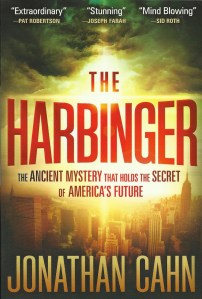
#17: The Harbinger (Jonathan Cahn)

Recently, a friend and colleague shared a book recommendation with me that was passed on to her by her mother. Initially, I thought the book sounded intriguing, but not something that I typically enjoy. While driving to Pigeon Forge last week for a few days of rest, I again heard the book referenced on talk radio. When I went into a local bookstore looking for my next read and stumbled upon the book, I decided to give in and read it.

The Harbinger is a Christian examination of Isaiah 9:10 and its prophetic fulfillment in 21st century America presented as a novel. Set in New York City primarily, the work follows a journalist who encounters a mysterious prophet throughout New England. The prophet points out the Old Testament prophecy from Isaiah and then, through a series of engraved stones, begins to reveal the fulfillment of the prophecy in America beginning with the tragic events of 9/11. It’s only in the closing chapters of the book that it is revealed that the work is actually a “prophetic word” presented in the form of a fictional work in order to reach a larger audience.

I suppose we have to look at this work from two points of view. Simply as a book, the writing is easy to follow and has a decent flow to it. It’s not a terribly long read…..I plowed through it in a day and a half. Additionally, it is suspenseful. I found myself coming back time and again to find out what was happening next.

I will be the first to admit that I approach the few prophetic writings I read with lots of skepticism. While I don’t know that I agree with everything presented here, I must admit that the logic and parallels drawn between the situation in ancient Israel and modern America are laid out clearly and appear to be plausible. I further appreciated Cahn’s extensive footnotes to aid the reader in separating fact from contrived fiction.

Whether or not I agree with everything presented in the novel, the message is clear: America needs to repent and return to the God of her earliest foundations or face the judgment of God upon our nation. Simply by looking at our current situation as a nation, any Christian can see that our country’s political and moral choices do not reflect those of a Christian nation. It’s time for a change. The Harbinger may be just the read to draw the focus of many back to the precepts that are so important to “one nation, under God.”


Leave a comment »

#4: Getting Things Done (David Allen)

 I am horribly unorganized! My desk is a mess and I never feel as though I am accomplishing everything I need to get done.  Recently, I read a friend’s blog post referring to the GTD method and, after asking him to clarify, decided to read the book for myself.  Honestly, I didn’t expect to find much that I hadn’t been exposed to before.

Quite simply, Allen’s method essentially is a combination of various lists and a thorough filing system.  At first I was very skeptical of the practicality of using seperate lists for everything — especially since I am away from my homebase much of the time.  Now that I have decided to give the method a try, I am finding it very refreshing to pull out my action list when I’m sitting at the computer and another when making phone calls.  I think that my productivity will greatly increase if I follow through with the method; that’s been the case this week, anyway.

The filing system is an alphabetical arrangement of everything.  No color coding or sub-files within a larger context here.  Rather than separating personal from business, everything co-exists in a single system.  I’m just getting started with my personal filing, so we’ll have to see how this actually goes.

Lists are not always date specific.  Rather, they represent the “next action” that needs to be taken for each project currently on your plate. The lists are reviewed weekly and adjusted and amended as needed at that point.

All in all, I think most people can take something away from reading “Getting Things Done.”  Written primarily from a business perspective, it is not leisure reading.  Whether or not you decide to implement Allen’s method (or even if you don’t think you need to improve in your personal organization), the book is insightful and full of useful information and ideas for improving your productivity.

4 out of 5 stars!

Leave a comment »