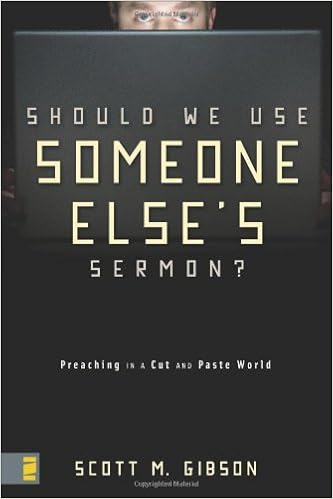
 While flying home yesterday, I decided to take a departure from my normal novels and investigate a topic that I personally find extremely important and that has arisen in several conversations this week. Scott M. Gibson’s Should We Use Some Else’s Sermon?: Preaching in a Cut-and-Paste World examines the history of plagiarism in the Church’s pulpits and focuses specifically on the responsible use of easily available sermon websites such as sermoncentral.com.
I am not a preacher or a pastor. I do not know the pressure of attempting to prepare a weekly sermon. However, I have been a faithful church attender. I have sat under the pastorate of men who had never spent a day in seminary and did the best they could to faithfully preach the Word of God under powerful anointing. I have also had the privilege of hearing wonderfully intelligent men present a finely-crafted and carefully researched sermon that was relevant and impactful to their specific congregation for that moment in time. Both scenarios have significantly contributed to my spiritual growth. Unfortunately, I have also found myself listening to a pastor present sermons found online. While the sermons were well written, they did not seem to have the power of personal conviction. Instead, I felt as though I was listening to a book report. How did I learn that the sermon was coming from a web service? Like most young adults in our society, I turned to Google. A quick search for a specific statement turned up the entire sermon — I followed along on my browser as the speaker read the material word for word. I found myself wondering if such presentations were ethical. If such excessive use of one person’s material was used in a presentation or document in any other field, it would be severely frowned upon — even if credit was given to the original author. Why was it now an acceptable practice that should not be questioned just because a “good man” was delivering it from a church pulpit? Are the ethics of the Church diminished in comparison to that of other professional fields?
While Gibson’s book focuses on ministers who present significant portions of their sermons — or even preach the entire sermon — without giving credit to the author they are “borrowing” from, he does address the current trend of using sermon internet services. Gibson quotes Eugene Lowry, Emeritus Professor of Preaching at the St. Paul School of Theology, who states that “While not plagiarism, using these sermons [from internet services] is thievery of another kind….When we substitute purchased sermons for that personal reflection, we betray people’s time and trust and our own integrity. It would be more honest to have the real writer tape [on audio recording] the text, and to play that tape for the congregation. For the pastor to present someone else’s sermon as if it were the result of his or her own discipleship, training, and theological commitment is to bear false witness.” (Gibson, 71-72).
Gibson follows this discussion with a observation from Ken Garfield, a reporter with the Charlotte Observer. In his 2002 article entitled “Internet Inspiration for Preachers,” Mr. Garfield concludes that “If all this leaves you nervous, you’re not alone. Preachers surfing for inspiration worries me too. There’s a risk of outright plagiarism, of course. But a subtler danger is at work — pastors choosing to take a shortcut to a sermon rather than putting in the effort that a congregation has a right to expect of its spiritual guide.” (Gibson, 72). Gibson finally summarizes his feelings about the use of internet sermon services with this statement. “What is the bottom line when it comes to these and other resources? A responsible preacher does the majority of his or her own work, possibly stimulated by various preaching resources [emphasis added], and prays to God for wisdom, guidance, and discernment.” (Gibson, 72) Personally, I fully agree with Gibson’s summary. Using resources is not the problem; actually, it should be applauded. The problem is when a minister fails to use the resources responsibly and puts all of their confidence in one man’s interpretation rather than faithfully doing the research on his own and then applying it to the Word as he understands it. I would much rather hear a less eloquent sermon that has come from a pastor’s wrestling with the text than reading what someone else has written. You see, I would rather know that you had spent more time reading the Word and listening to the direction of the Holy Spirit, Mr. Minister, than reading the thoughts of another man. “All Scripture is God-breathed” (2 Timothy 3:16)……not all sermons crafted by fallible men.
Should We Use Someone Else’s Sermon? is certainly not the final authority on this topic. However, it does begin to raise an important question for the modern Church that must be addressed by ministers, lay leadership, and congregants alike and no longer swept under the carpet.

 Reading for Me